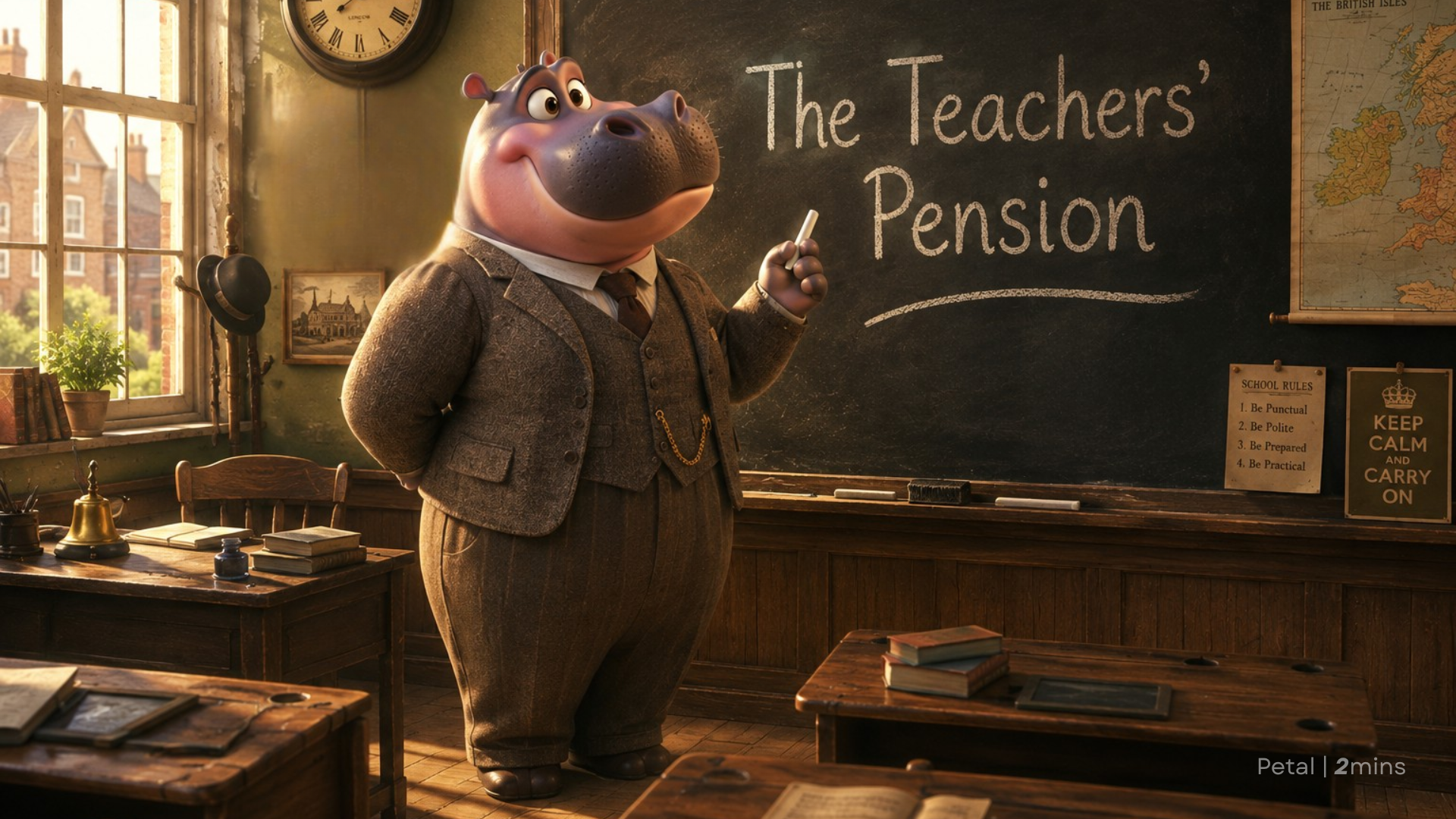
This is the story of the Teachers’ Pension Scheme.
Our story begins over 100 years ago, when teachers smoked in classrooms, blackboards didn’t need turning off, and students were yet to use “scroll” as a verb. A simpler time.
In the beginning
Once upon a time, the Government made the Teachers (Superannuation) Act of 1925, creating the first national pension scheme for teachers in England and Wales.
The pension was a final salary scheme, meaning the pension you received in retirement was based on:
- how many years you’d taught
- your salary towards the end of your career
For many, receiving a promotion lastminute.com could significantly increase their pension value. So it wasn’t a bad idea to spend a couple of years as Head of Maths (yawn) if it meant you could spend a few extra bob on trips to the seaside in retirement.
This dandy little situation remained broadly the same for decades.
Fast forward to 2007
By the early 2000s, it became apparent that people were living much longer (perhaps a result of all those extra seaside ice creams).
And so, to help keep the Teachers’ Pension Scheme economically sustainable, changes needed to be made.
In 2007, the scheme was still a final salary scheme, but the retirement age for new members increased from 60 to 65, contribution rates were changed and a few other rules updated.
The big change of 2015
Following an independent review of public sector pensions, the Government concluded that they needed to better reflect longer life expectancy and the rising cost of providing pensions.
Teachers began building up new pension benefits under a Career Average Revalued Earnings scheme or “CARE” (a particularly cunning government acronym).
Instead of basing your pension on your salary near retirement, this new scheme builds your pension year by year based on what you earn, with each year you teach adding a little more to your future pension.
But wait…did that mean teachers had to start building up a pension from scratch?
No sir-ee!
Thankfully, any pension benefits teachers had already earned were protected under the rules that applied at the time.
The new scheme simply changed how future pension benefits would be built up.
A courtroom drama (2018–2022)
Controversially, not everyone moved to the CARE scheme in 2015. Teachers who were closer to retirement were allowed to stay in the final salary scheme for longer, while younger teachers had to move across straight away.
A legal challenge known as the McCloud case argued that these age-based protections were discriminatory under the 2010 Equality Act. The courts agreed.
As a result, eligible teachers will have a choice over whether their pension benefits for the period between 1 April 2015 and 31 March 2022 are calculated under the final salary or CARE scheme.
So…which scheme am I actually in?
Since 1 April 2022, everyone actively paying into the Teachers’ Pension Scheme has built up new pension benefits under the CARE scheme (easy breezy, squeeze the lemon).
But if you were a member before then, things can be a little more complicated. You may also have benefits under the old final salary scheme and, if you’re affected by McCloud, you’ll eventually have a choice over how your benefits are calculated for the period between 1 April 2015 and 31 March 2022.
The good news?
You don’t need to work it all out in your head!
If you’re a member of the Teachers’ Pension Scheme, you can log in to My Pension Online to view your pension record, see how much you’ve built up (including if you’re affected by that pesky McCloud) and access your Benefit Statement.
And with that, the teachers lived happily ever after…or at least, they became a little more pension-savvy!